Buyer's Guides
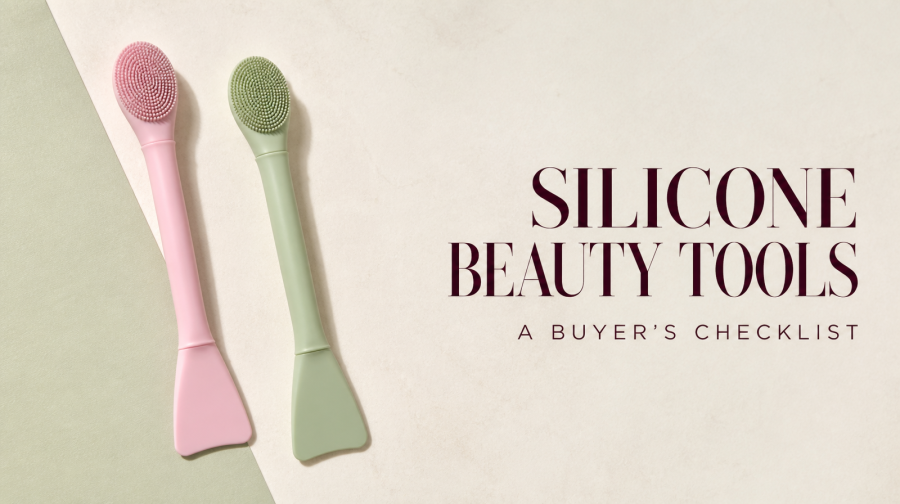
Silicone Beauty Tools: What Buyers Should Confirm Before a Private-Label Order
Silicone tools look simple on a line sheet and become complicated the moment production starts. Material grade, surface feel, cleaning behaviour, colour, mould design and packaging all interact - and each one has to be agreed before tooling is finalised.
This article is a working checklist for sourcing managers and brand owners preparing a private-label silicone beauty tool such as a face mask brush or mask applicator. It deliberately avoids unverified material claims: if a grade or certificate has not been confirmed in writing for your project, it should not appear on your product page.
Start With the Material Conversation
- Which silicone grade is proposed for this tool, and why is it suited to the intended use?
- Is the item a single component, or does it combine silicone with another material such as a handle or spatula?
- What documentation can be provided for the exact grade used in production?
- Are there temperature or cleaning requirements the material brings with it?
Do not accept general statements such as "food grade" or "medical grade" as a product claim unless your supplier confirms the specific grade and supplies supporting documents for it. Until then, keep that wording off your listings.
Touch, Flex and Cleaning
Surface feel
Silicone can be produced with different surface finishes and hardness levels. Confirm the intended feel on a physical sample, and check how the surface reads in close-up photography.
Cleaning and care
Ask what cleaning method the finished tool tolerates and what care instructions should ship with the product. This becomes your instruction card or packaging copy, so agree it early.
Edge and seam quality
Check the sample for moulding lines, flashing and edge finish. These are the details customers notice first.
Confirm These Points Before You Approve a Mould
- Final drawing signed off by both sides.
- Colour reference matched on a physical sample.
- Hardness and surface finish agreed in writing.
- Logo placement, size and application method confirmed.
- Packaging dimensions finalised so the tool fits without pressure.
Reminder: a mould decision is difficult to reverse. Approve drawings and samples first, and only then confirm tooling.
Documents to Request From Your Supplier
- Material specification for the exact grade proposed
- Any test reports the supplier already holds for that grade
- Care and cleaning instructions for the finished product
- Packaging artwork proof with dimensions
- Pre-shipment inspection checklist
Sample Inspection Points
| Check | What to look for |
|---|---|
| Surface | Consistent finish, no visible marks or contaminants |
| Edges | Clean, with no sharp or uneven trim lines |
| Colour | Matches the approved reference in daylight |
| Flex | Behaves as agreed during normal handling |
| Logo | Correct size, position and legibility |
| Packaging | Tool fits correctly and artwork matches the proof |
Reference Product
Our dual-ended silicone face mask brush and spatula is a useful example of how a simple silicone tool can carry two functions. Use it as a shape reference, and confirm every material and care detail against your own approved sample.
Talk to Us Before You Tool Up
Send your silicone tool reference, intended use and target quantity. We will tell you what needs to be confirmed at sample stage, and what documentation can realistically be provided for your market.
0users like this.